

Faery is a Flat Circle
Radical Elphame Essay Series Part 6

Note: This is the sixth part in an essay series on the nature of what we call faeries. Feel free to dive in here, but it will reference concepts explored in greater depth in the previous five essays.
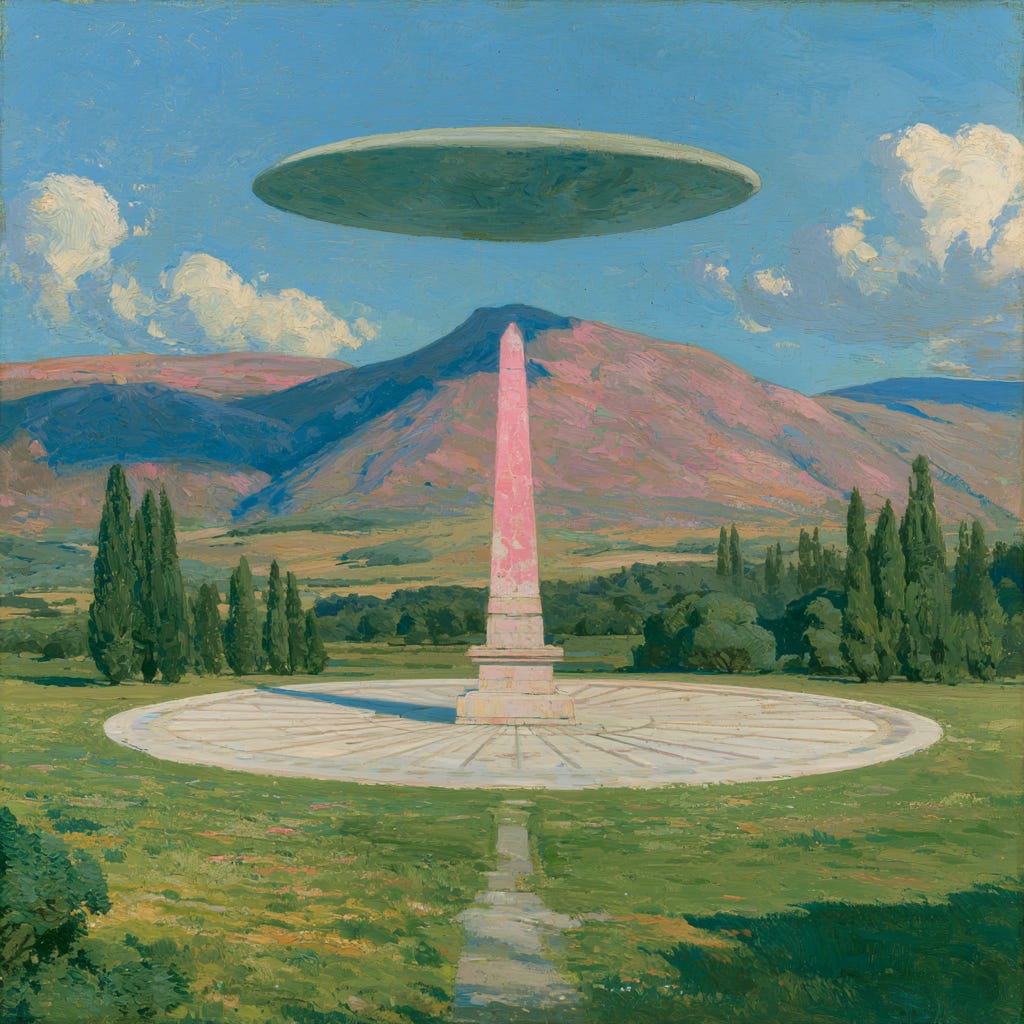
In the annals of folklore and fairytales, one of the most universal tells that someone from this world has entered The Otherworld is the realization that, to quote Hamlet, “time is out of joint.” According to the Scottish legend of Thomas the Rhymer, what feels like three days in Faery is actually seven years in our world. When Oisín, the bard of Ireland’s mythic Fenian Cycle, is brought to Manannán mac Lir’s island of Tír na nÓg, or “the Land of the Young,” what feels like a three-year sojourn with his new Faery lover turns out to have been 300 years in his mortal home. While this leads to a tragic end for the son of Fionn Mac Cumhaill, it also gives him the unprecedented opportunity to meet Saint Patrick and land some choice barbs that even the Christian scribes transcribing the story chose not to omit. In many tales, time doesn’t only appear to move more slowly in Faery, but rather to operate according to even more bizarre and unknowable rules. In Faery, it’s rumored, even the most archaic of timekeepers we have, our celestial luminaries, seem trapped in the gloaming of the liminal moments just before the sun has risen or set, reportedly giving it a feel of eternal twilight. The most powerful inhabitants of Faery, its titular Queens and Kings, also appear to embody this disregard for sequential time. The Queen of Elphame in the Ballad of Thomas the Rhymer, the Morrígan in the Táin Bó Cúailnge, Manannán mac Lir in Eachtra Bhodaigh an Chóta Lachtna & Manannan at Play, Dame Ragnell in The Wedding of Sir Gawain and Dame Ragnelle, Morgen le Fay in the Vita Merlini. All of these famous stories describe elevated faeries becoming rapidly older and younger at will.
The Glamour of Nostalgia
One of my most Faery-coded dream experiences followed an offering I made on a Midsummer’s Eve. The dream appeared to take place in one of those cliché “Old Western” towns, just begging for a gunslinger’s duel at “high noon.” Weirdly, though, it wasn’t a Back to the Future Part III situation, where I was actually experiencing the past, but rather more of a Westworld situation, like I was on a movie set, and everyone knew it. Thankfully, the point of this Western locale didn’t involve abusing any LARPing robots, but was sort of a hipster resort, a la the Ace Hotel, designed to make guests feel like they are on the set of a 1970’s “Spaghetti Western.” It’s unclear if the guests were conscientiously dressed as actors and filmmakers from the 1970s, or if this is just what the HOA of Austin and Brooklyn, [vibe executors to the world] respectively, has determined to be “in,” but amongst guests drinking at elevated “saloons” spinning Italo-Disco, and lounging in an oversized “stock tank” pool, were more conspicuous bystanders, who seemed lest distracted by the resort’s glamors, and more interested in noticing if I was noticing that they were noticing me. They would give me knowing glances as I walked around the town that seemed to denote less “how’s it going?” and more “do you see what we’re doing here?” Three of these Otherfolk were a trio of beautiful women, whom I passed over and over again. Each time they passed me, they would laugh as though the joke were on me. They were always in the same Bohemian-chic attire, but their ages ranged from twenty-five to seventy-five and back again; each time they crossed my path. There was no crazy climax to this dream. The age-shifting ladies didn’t whisper any grand gnosis into my ear. When I woke up, though, I had no doubt that my Midsummer offering had been received.
Although this dream might seem relatively simple, with nothing but glances and vibes, it manages to tap into many of the more nuanced ways time is eschewed in Faery. A simple reading of this dream might emphasize the potential role of nostalgia in how we experience Faery. The term nostalgia wasn’t coined until the seventeenth century, but you would be hard-pressed to find a time before which humans didn’t experience a sense of homesickness for the past. On a macro level, nostalgia is experienced when we mourn the comforts of simplicity that must be sacrificed in the name of progress, largely expressed through technological advances. On a personal level, though, we often experience nostalgia most potently through culture. As technology and culture have been combined, our experience of nostalgia has grown increasingly acute. First, via the printing press, and then photography, our relationship to culture and memory became less something to be experienced and instead something that could be collected, revisited, and personalized. This effect was dramatically accelerated in the twentieth century with the proliferation of what we now call “media”–records, film, television, and the fashions they reflect.
Throughout the twentieth century, if you track the evolution of fashion, music, and film in the “West,” you will see a steady progression of change that incorporates technological advances and cultural mores in pursuit of increasingly liberal values. Interestingly, though, you’ll also see a fairly consistent trend of nostalgia represented in media from roughly twenty-five years before any given moment. This rarely manifests as a desire to reverse the technological tide to experience life as it was in the past, but rather a desire to depict it using the latest technology. You can see this effect as far back as the “Gay Nineties” Craze in the 1920s, when, after the trauma of WWI and the acceleration of urbanization, there was a desire to relive the comparatively halcyon 1890s. Strangely, the ubiquity of the home television coincides with this twenty-five-year retrospective nostalgia, manifesting not only during moments of cultural upheaval, but as a permanent phenomenon in twentieth-century Western media. In the late seventies, you had the popularity of movies like Grease and shows like Happy Days. In the eighties, you had a glut of films re-litigating the Vietnam War alongside more nostalgic productions like Stand By Me and the show The Wonder Years. In the early nineties, a The Doors biopic and Grateful Dead revival gave way to the seventies-influenced films Dazed and Confused and Boogie Nights as the decade progressed. I could go on. Why would this retro cycle become so endemic to Western media in the twentieth century? The most obvious answer would be that every twenty-five years, a successive cohort of humans become adults by Western standards and can now yearn for their childhoods.
This homesickness for our childhoods is obviously not a twentieth-century invention, but the technological advancements that enabled film, music, and television companies to feed this inherent human longing via inexpensive, repetitive ways for profit definitely were. What is the difference between a television show or movie about a contemporary detective solving a mystery, and one set when I was a kid, and first becoming fascinated with the occupation of detective in the first place? Just like junk food is technologically designed to trigger stronger dopamine releases, this form of entertainment, which compounds the stimulation of moving pictures with nostalgia for our childhoods, will sell more movie tickets and keep us glued to our TVs longer, increasing ad revenue; therefore, it has essentially become dictated by our Capitalist-driven society. What we’re describing when we compare taking a contemporary detective show and increasing its desirability through the trappings of our nostalgia is one example of what we call glamouring in the world of Faery.
The great Fortean writer, Joshua Cutchin, often points out the juxtaposition that while the UFO phenomenon often appears to us through technology just advanced of our own, faeries are typically experienced in a manner that harkens back to the past. Does this observation hint at the Faery realm having an outdated fashion sense, or is it telling us something about how they might be curating their appearance to affect how we experience them? Regardless of the motivation of the denizens of Faery, it would seem that this strange relationship to time in terms of their appearance is likely a feature, not a bug. If we want to see a relationship between the Faery phenomenon and that of the UFO, as explored in more depth in my previous essay, does Joshua Cutchin’s observation about how these anomalous forces tend to manifest in diametrically opposite ways present us with a conundrum? It doesn’t, if we consider that the same dopamine release that occurs in us when confronted with nostalgia also occurs when we’re confronted with stimuli that make us feel hopeful. In this instance, we can be using the word “hope” in the way it was used on Obama’s campaign posters leading up to the 2008 Presidential election, but also to describe the less altruistic experience of imagining a desired outcome. To use twentieth-century marketing jargon, just as movies and television tend to depict characters with aspirational socioeconomic situations rather than reflecting those of the average viewer, representations of technology just beyond what we consider mundane inspire us to feel optimistic and excited, essentially evoking a form of anticipatory nostalgia for a better, or at least more advanced, future. This anticipatory nostalgia, not unlike the feeling of a child seeing their Christmas presents laid out on Christmas Eve, elicits the same dopamine release as depictions of simpler times on television.
In the context of Faery, the word “glamour” often describes a deceitfully alluring veneer magically placed upon an object, being, or entire location, typically designed to lure someone into a playful or malicious charade. Throughout Faery lore, you’ll hear tell of unsuspecting humans stumbling into hollow hills and discovering grand palaces replete with ornate feasts set before a faerie monarch, only to have this glamour fade, revealing nothing but a dank cavern and rotting leaves. It’s this Faery glamour that provides Cinderella with a gilded carriage, only to have it turn into a pumpkin at midnight. This notion of Faery glamour often feels like an antiquated description of what we now refer to as “High Strangeness,” in which an uncanny overlay serves as a tell that some form of phenomenon is employing obfuscation to mysterious ends. In the late 19th century, some of the earliest UFO reports were experienced as so-called “air ships,” behaving very much like mundane sea ships of the time–sometimes with anchors, sails, and even a very human-seeming crew–but they were flying in the sky, prior to the advent of airplanes. These sorts of encounters strongly complicate the Extraterrestrial Hypothesis of UFOs, since, with hindsight having now experienced a century plus of aircraft technology, the tech represented by these steampunk airships is clearly absurd, not to mention the idea that whoever is piloting these crafts has technology progressing only a few decades ahead of our own in perpetuity, but somehow simultaneously has already achieved advanced interplanetary travel. On the terrestrial side of the phenomenon, we also have so-called “Men in Black” encounters, which have featured in our modern conception of UFO lore since it kicked off in the Pacific Northwest in the Summer of 1947. These stories involve bewildered experiencers being stalked by purported government agents wearing out-of-date clothes and driving old-fashioned cars, who exhibit bizarre behavior, such as starting off an interrogation by asking, “What year is it?” Intentions and origins of this phenomenon aside, it seems to attempt, with varying degrees of efficacy, to manipulate or subdue the experiencer by employing techniques of glamour.
The entropic worldview, which we explored in depth in the first essay in this series, which is exemplified by monotheistic religion, would read the deceptive applications of glamour in these cases as clear evidence that these mysterious forces can offer us no boons and that spiritual entanglement with them will only yield empty promises at best. Just like it’s easy to see the employment of techniques to release increasingly more dopamine amongst the economically consumptive masses by junk food companies and advertisement executives as a largely parasitic force, it would be easy to see how the phenomenon that may be behind what we call Faery and UFO encounters might be employing malefic, coercive techniques on experiencers. Another perspective might be to remove morality from the equation entirely and simply see the co-creative aspect of manifestation on the part of the Others, in these scenarios, as the most effective way for beings from a realm beyond our understanding to interface with our own without appearing incomprehensible or terrifying, thereby negating any end goals to their reason for interacting with us, be they positive, negative, or neutral.
One interesting outlier in our understanding of a potentially wider phenomenon’s use of traditional and anticipatory nostalgia might be the bizarre perennialism of the Renaissance Fair aesthetic to our conception of Faery. Why would contemporary United States citizens, for instance, living centuries removed from any form of monarchy, encounter Faery Queens or Kings during psychedelic trips or other voluntary or involuntary trance states? Is monarchy and the late Medieval period somehow endemic to Faery, and an exception to this realm’s otherwise playful employment of our own nostalgic impulses? I think it might actually be just as entangled with our nostalgia. While a re-run of SNICK or TGIF from the early ‘90’s might elicit a profound nostalgic response in me that it wouldn’t for my Mom or my Grandma or my Great-Grandma; all four of us have a rare, uniformly shared childhood experience of what we call, maybe uncoincidentally, “fairy tales.” Could it be a coincidence that the one seemingly timeless aspect of the Western conception of faeries happens to conform to one of the only perennial examples of children’s entertainment that has followed us since the Enlightenment? Could it also be a coincidence that the modern inception of the fairy tale, which has persisted to this day, coincides perfectly with the birth of the Enlightenment movement, which would forever change our relationship to The Otherworld, in the late Seventeenth Century?
Curated Cool
While my (literal) Midsummer night’s dream certainly alludes to notions of nostalgia and glamour in the Faery realm, it also seems to be hinting at an even weirder relationship between the Otherworld and time. Unlike a dream of being transported to the “Old West” a la Back to the Future Part III or Westworld, my dream, in a very overindulgent metatextual way, was a conscientious facsimile of an Italian film set in the 1970s, for an imaginary film set in the late-19th century “American West.” Is it possible that this unnecessarily complicated locale is merely the result of dream logic extrapolated from my brain defragging while I sleep? Maybe. As I mentioned when recounting my dream, though, this weird setting has a very tangible cultural relevance to my other life as a wine professional in 2026, as it represents the hospitality aesthetic that most effectively seduces me and many in my millennial cohort and beyond. What aesthetic am I referring to? I guess we could call it “curated cool.”
Prior to the internet, a curated cool aesthetic denoted taste and authenticity. It required work to achieve and was generally an extension of an individual’s creativity and passions. In the twentieth century, the curated cool aesthetic manifested through an appreciation of arthouse cinema, eschewing Top 40 radio for record store curios, and buying clothes from thrift stores–before they were called “vintage” and ceased to be thrifty. The curated cool aesthetic was fundamentally countercultural and, strangely, by rejecting macro trends, managed not to fall prey to the fickle whims of fashion, appearing timeless. The point of the curated cool aesthetic was that it couldn’t be commodified for the masses, but technology has changed that. The internet, and its extensions in the forms of YouTube, Spotify, Pinterest, Etsy, and social media, has done something strange to the way we engage with media and culture, and it has both commodified and democratized the once-scarce quality of “cool.” You can see evidence of this if you walk into any third-wave coffee shop, boutique hotel, or natural wine bar in the world and experience how their curated cool aesthetics are nearly identical. It’s worth pointing out, though, that even though this curated aesthetic has regretfully become commodified, it generally manages the unlikely feat of still feeling cool, even though it pains me to admit it.
As the 21st century has homogenized alternative tastes and aesthetics, it has done something even weirder to mainstream modes of fashion and culture, imprisoning them in a temporal loop of nostalgia and breaking the twenty-five-year retrospective nostalgia progression we explored earlier in this essay. The great philosopher and cultural theorist Mark Fisher described this shift as “the slow cancellation of the future.”
The slow cancellation of the future has been accompanied by a deflation of expectations. There can be few who believe that in the coming year a record as great as, say, the Stooges’ Funhouse or Sly Stone’s There’s A Riot Goin’ On will be released. Still less do we expect the kind of ruptures brought about by The Beatles or disco. The feeling of belatedness, of living after the gold rush, is as omnipresent as it is disavowed. Compare the fallow terrain of the current moment with the fecundity of previous periods and you will quickly be accused of ‘nostalgia’. But the reliance of current artists on styles that were established long ago suggests that the current moment is in the grip of a formal nostalgia...
Fisher, Mark. (2014)
Fisher saw the emergence of this cultural temporal loop as a symptom of what he called “Capitalist Realism,” in which we collectively lost the ability to imagine a post-capitalist world even as we increasingly experience its failures. To Fisher, the experience of Capitalist Realism at the dawn of the 21st century left the West in cultural paralysis, clinging to the nostalgia of a time when we didn’t yet feel that the Capitalist system had failed us, and thus unable to face the future. While I’m very sympathetic to Fisher’s conception of Capitalist Realism, I don’t think it’s the only explanation for “the slow cancellation of the future.” In fact, I think there might be a single cultural moment we can examine that prestaged the breakdown of the twenty-five-year retrospective-nostalgia progression, and it has many unexpected parallels with the realm of Faery.
Spaghetti Westerns
It may sound strange, but while most people in my millennial cohort may have never seen a “Spaghetti Western,” this film genre plays a key role in the “curated cool” aesthetic that has become ubiquitous in how we now experience fashion and media. More popular today than any of the original run of Spaghetti Westerns from the 1960s and ’70s are probably Quentin Tarantino’s deeply indebted homages to them. While Tarantino has made two films that could be described as essentially Neo-Spaghetti Westerns in form and approach, the DNA of the Spaghetti Western runs through all of his films, whether they’re about LA gangsters, revenge-seeking samurais, or Jewish Nazi hunters. It’s the Spaghetti Western DNA, stripped from the Spaghetti Western, that Tarantino exploited to build a wildly successful film career, and our culture has absorbed it as somehow essential to what we now experience as “cool.” What is it that made Spaghetti Westerns, and by extension Quentin Tarantino’s adoption of their aesthetics, so cool, though?
Although there were some crossover mainstream hits that transcended the genre, Spaghetti Westerns were a strange product of the 1960’s and ‘70s that could more broadly be classified as “exploitation films.” “Nun-sploitation,” “Black-sploitation,” “Shark-sploitation,” “Giallo” films, “Chambara” movies–I could go on. These were low-budget films that sought to exploit the themes of mainstream genre movies, skimming off their viewership, and often injecting gratuitous violence and sex into their stories to cater to the late-night “Midnight Movie” crowd. “Spaghetti Westerns,” so-called, because they were cheap Italian knock-offs of their big-budget Hollywood inspirations, made up for their lack of production value with hyperstylized cinematography and a penchant for gritty anti-heroes, subverting the traditional jingoistic Western tropes of American productions. Unlike more respected cinema, most exploitation films were made to be disposable. The goal of these films was to capitalize on a cultural moment, make money, then disappear. Why, then, would the Spaghetti Western, a strange relic of the 1970’s, play a key role in how we experience fashion and media today? You could argue that, almost by accident, the nature of the unique economic reality of the Spaghetti Western, which dictated its subversive themes and international influence, unlocked a strange hauntological brilliance in these films, as Philip K. Dick would say, “from the trash stratum.” Unlike the Hollywood-produced Westerns of the 1950’s and ‘60s that mined American nostalgia for the propagandized depiction of the Westward Expansion, Spaghetti Westerns didn’t celebrate this frontier myth, directly challenging the viewer’s sense of how they remembered their own nation’s origin story. The protagonist of the Spaghetti Western is not the valorized agent of Empire on a mission to colonize the West to perpetuate its entropic agenda of eradicating the non-entropic natives. The Spaghetti Western sees picking a side in the order-chaos dialectic for what it truly is, a Catch-22, and instead glorifies the morally ambiguous “anti-hero” acting in opposition to the corrupt reality of the Western Frontier. It’s important to point out that this sort of close reading and reconsideration of a form of media largely designed to be disposable only became possible for one reason, and it has everything to do with how the exploitation film became so intrinsically linked to what we now consider “cool.” A strange technology would soon come along that would thwart the dust-binned fate of the self-destructing exploitation film: home video.
When Quentin Tarantino’s Pulp Fiction premiered at the Cannes Film Festival in 1994, although the discourse surrounding the film was largely centered on its gratuitous depictions of violence and Tarantino’s liberal use of the N-word, the film’s groundbreaking genre-transcending achievement was largely attributed to the fact that Tarantino had previously been a video store clerk. In the 1980’s, the proliferation of VHS and Betamax home videos would irrevocably change how we experienced cinema as a culture. Alongside classic mainstream films, home video resurrected arthouse and even low-budget exploitation films. In its nascency, VHS tapes were still prohibitively expensive for most, and videos were predominantly experienced by renting new releases to watch at home. The first to experience the full paradigm-shifting potential of home video and its implications for how we engage with the media was about to change were the video store clerks. Not only did the video store clerks have access to a vast catalog of mainstream and obscure films spanning the lifetime of the medium, but they also had the rare privilege of rewatching the same films over and over again, until they were no longer merely experienced, but could be analyzed, dissected, and reconsidered. While most of the viewing public was still caught up in the novelty of watching new releases from the comfort of their own couches, the video store clerk was getting bored with mainstream fare and seeking out rarer, more novel cinema to whet their appetites. For video store clerks like Tarantino, exploitation films, armed with a rewind button, could now be experienced not as disposable cash grabs, but as high art. Having the insider’s eye to see the novel artistry at work in the exploitation film was the pinnacle of the aficionado’s reconsideration of the medium, spurred by this new technological breakthrough. Film could now be mined for eccentric curiosities in pursuit of a curated cool aesthetic, much like an old jacket at the thrift store could be reappropriated as part of a hip new ensamble. In fact, Pulp Fiction is essentially Tarantino reappropriating the entire video store into a form that transcends the sum of its parts and, in doing so, prophetically depicting the impending breakdown of our culture’s relationship to media entirely. How was this possible? By stepping out of linear time.
The glamour of Pulp Fiction lies in its crystallization of the “curated cool” aesthetic for the totality of the twentieth-century media landscape. You can see the seeds of this approach in various works by David Lynch and Jim Jarmusch, which dip into this aesthetic to aid a story, but in Pulp Fiction, the style is the substance. David Lynch uses nostalgia to interrogate our relationship to the past; Jim Jarmusch explores how nostalgia can depict a character feeling out of step with the present. Pulp Fiction, by contrast, doesn’t use nostalgia as a tool but rather exists in an alternate dimension where linear time doesn’t even exist. I imagine that some people reading up to this point are starting to scratch their heads and ask themselves, “What the hell does Pulp Fiction have to do with faeries?” In a weird way, almost everything. Sasha Ravitch once turned my perspective of the “Fairy Tale” on its head when she pointed out that perhaps fairy tales aren’t humans telling stories about faeries, but rather “fairies telling stories about humans.” Viewed through this lens, all the elements that made Pulp Fiction exhilaratingly unique and deeply weird for its time make complete sense. Pulp Fiction is a Neo-Noir gangster movie as if made by faeries. Pulp Fiction is not set in the past, the present, or any specific era, although it depicts elements of all the eras we see represented in film over the last century. Essentially, Pulp Fiction is the first cinematic representation of Australian philosopher J.J.C. Smart’s “Block Universe” concept, which combines Einstein’s theory of relativity, space, and time into an unchanging, four-dimensional continuum known as “spacetime.” The “Block Universe” theory posits an underlying structure of our reality that, although we experience it as a three-dimensional linear progression, is actually unfolding on a four-dimensional “block” of spacetime in which the past, the present, and the future all exist simultaneously. Does the “Block Universe” concept give us a parsimonious glimpse into the land of Faery’s bizarre relationship with time? Is our interaction with the Otherworld less of a Fourth-Wall break, like we explored in the previous essay, and more of a Fourth-Dimensional break? If so, Pulp Fiction would not be depicting faeries in Faery, but showing us what a human story would be like if it operated by Faery rules.
Beyond the simultaneity of eras depicted in Pulp Fiction, another clue that it might operate in a Block Universe is its trademark non-linear storytelling. Told through the form of vignettes, when viewed in aggregate, characters are killed only to resurrect in a later scene; dialogue halfway through the film delivers an exposition dump about a setpiece that has already happened; and the movie as we experience it is bookended by a single event. In 1994, this approach to filmmaking was truly novel, but from the perspective of our theoretical Otherworldly Block Universe, this would simply be the most interesting and effective way to engage with a story that isn’t bound to linear time. What would an experience of reality in this way change about us and the stories we tell? Reality, viewed from a fourth-dimensional non-linear perspective, would likely desensitize us to the consequences of finality and loss, and we might expect to encounter an increase in dark humor and a more irreverent attitude toward violence. The characters in Pulp Fiction do not portray a relatable depiction of the human condition, but rather embody a veneer of Neo-Noir clichés, with the interiority of beings who exist at a remove from the story they’re in. From our perspective, these characters should be talking about how to survive the life-and-death struggles they are currently trapped in, but from the vantage of the Faery Block Universe, they choose instead to talk about European fast food, failed TV pilots, and the inflated cost of milkshakes. These are the kinds of conversations that might unfold if all the characters were experiencing the events of the story in a time loop, à la Bill Murray in Groundhog Day. In a Faery Block Universe, maybe they would be. I think this is what my Midsummer night’s dream was showing me in its depiction of our contemporary commodification, or perhaps crystallization, of the curated cool aesthetic. To be “cool” is to embody an approach to life as though you are a being of the fourth dimension, merely playing a part in the third, and not too concerned about it.
The Web of Time
Even though Quentin Tarantino has had some bad takes of late and seems to revel in his “complications,” I can’t really overstate how significant I think Pulp Fiction as a piece of art has been in reshaping our culture. As an animist who doesn’t subscribe to the auteur theory, I don’t really credit Pulp Fiction’s importance to Tarantino all that much, but rather would point to the quote often attributed to Carl Jung that “people don’t have ideas; ideas have people.” The idea in this instance, I think, was more akin to a prophetic gnosis about the paradigm shift our culture would soon undergo, not just in the media, but in how we experience and engage with reality. It just so happened that the perfect person to express this idea needed to be a video store clerk, because of the rare opportunity granted him to get an early taste of a form of engagement with media that would soon become standard for everyone. So, if Mark Fisher blames the “Slow cancellation of the future” on Capitalist Realism, am I suggesting the culprit is actually an early ‘90s Neo-Noir movie? No. But the cultural paradigm shift that I think Pulp Fiction prophesied made the “slow cancellation of the future” inevitable. The internet.
In April of 1993, while Quentin Tarantino was finalizing the script for Pulp Fiction, the European Nuclear Research laboratory CERN released the “World Wide Web” into the public domain. Although it would take years for the internet to be adopted by the mainstream, by the end of the ‘90s, it would completely upend the music industry through the proliferation of programs like Napster. Within roughly a decade, social media would be born, YouTube would revolutionize how we consume visual content, and the first smartphones would be released to the public. It wouldn’t have seemed obvious to moviegoers having their minds blown by Pulp Fiction in 1994, but a burgeoning technology would soon make Tarantino’s most novel creative qualities an inherent extrapolation of culture in the twenty-first century, propelled by the internet. With the internet, you don’t need to have a hip older sibling to turn you on to deep cuts, or sneak into Midnight Movies to experience avant-garde cinema, or uncover a rare and curated thrift store to cobble together a bespoke fashion sense. Music has become so thoroughly democratized that no scene or era is out of reach of a bored teenager, and algorithms can curate good taste with minimal effort. Metatextual detachment is now not only reserved for MFA novelists and indie films, but is standard in children’s movies. “Cool” is no longer a rarified quality but essentially a commodity.
Pulp Fiction essentially defined what would go on to be called independent cinema in the popular imagination and inspired most writers and filmmakers for the next decade. At first, this manifested as an aping of Tarantino’s dialogue, for better or worse, and an influx of darkly comedic gangster stories à la Elmore Leonard. Until the twentieth century, the progression of “the culture” still seemed directed toward some kind of media-entangled future, evolving from grunge to techno to nu-metal. It wasn’t until the early twentieth century, with the wider proliferation and advancement of the internet, that Pulp Fiction‘s prophecy of the cancellation of the future began to take shape. The film Donnie Darko was released in 2001, a month after the Twin Towers collapsed, and due to its apocalyptic themes and the key plot point of a plane crash, the movie was initially largely overlooked or avoided. With time, though, Donnie Darko became a cult classic on video and has since become influential in its own right. Unlike Pulp Fiction, Donnie Darko is a coming-of-age sci-fi movie with a linear plotline, despite incorporating time-travel elements, and has a clearly defined era setting: the late 1980’s. I don’t find many surface-level connections between the two films at all, really, but I think Donnie Darko might be one of the first films to demonstrate that the “slow cancellation of the future” that Pulp Fiction prophesied was beginning to take hold. There’s a close reading to be done of the connection between Donnie Darko and our experience of the Otherworld, but for our purposes, I just need to point out how it breaks the twenty-five-year retrospective-nostalgia progression that had previously been baked into twentieth-century media output. Donnie Darko was written less than a decade after its 1988 setting, and released only twelve years later, but it feels as nostalgic for the Amblin-coded era as Grease did for the 1950s or Stand By Me did for the 1960s. It’s not that Donnie Darko pre-staged an era of some sort of nostalgia speed-up, but rather a nostalgia singularity. As a culture, we’ve been experiencing the same nostalgia for the 1980s ever since Donnie Darko was released, as evidenced by Adventureland and The House of the Devil in 2009, Super 8 in 2011, Ready Player One in 2018, and the entire run of the massively popular Netflix show Stranger Things, which just released its final season in 2025, just to name a few. And you can make similar observations of our 21st-century culture being locked into a perpetual nostalgia time loop not only for the 1980s, but for pretty much every era after the advent of television until the internet found its footing in the early ‘00s. While I’m sure there are aspects of 2026 that my daughter will be uniquely nostalgic for in twenty-five years, they will be so entwined with these much older retrospective-nostalgia time loops that her cultural memories of this year will be hard to untangle from a nostalgia she has for a past she never experienced.
If my speculation is right that the internet is responsible for the “slow cancellation of the future” and that Pulp Fiction acted as some sort of prophecy of this eventual reality, what significance does that have on our present examination of the relationship between Faery and time? A lot, actually. This notion of a fourth-wall break and, by extension, perhaps a fourth-dimensional break keeps coming up again and again throughout this essay series. From our consideration of Terrence McKenna’s Stoned Ape Theory in conjunction with Margaret Murray’s Witch Cult hypothesis, the Promethean moment at the birth of civilization and its potential ties to a collapsing of the order-chaos dialectic into a new struggle between symbiosis and parasitism, and on the most personal level, the experience of an individual being led or abducted into what feels like an Other world, which we might see as operating beyond the confines and limitation of this world. The arrival of the internet seems to be a technological force ushering in a paradigm shift of similar flavor, if not necessarily of equal ontological magnitude. And what is the internet? A web. As CERN called it, a “world wide web.” This is where I need to resist my reflexive instinct to think like a middle-aged luddite, and see the “slow cancellation of the future,” the internet, and the technologies that the internet hath wrought–such as smart phones, social media, and AI–as inherently dystopic forces of cultural, intellectual, and spiritual degradation.
With a 10,000-foot view, the internet itself is conceptually porous–to borrow a notion from Meredith Spearman–or Non-Entropic–to quote Tyson Yunkaporta–technology, which, uncorrupted, unlocks a mycorrhizal interface to democratize ideas and communication. The internet was born out of the psychedelic revolution, and was originally imagined as a means to encode hardware with the utopian qualities psychedelics were believed to offer humanity. From this perspective, the internet, by breaking down the barriers that separate us as individuals, subcultures, and nations, might usher in a form of digitized telepathy that could dissolve our differences and promote global cooperation and symbiosis. This is how Terrence McKenna imagined the internet might evolve,
I think that somehow, the way back to the archaic—to the world of ecological balance, and low technology, and retraction of toxic infrastructure, and all of that good stuff—doesn’t lie in some kind of Luddite know-nothingism or some kind of fascist program of limiting population, and this sort of thing. . . . Instead it has to be a forward escape: a forward escape through technology, but technology that serves an agenda of archaic revivalism. . . . The people who are running the Internet at the developmental and cutting-edge level are very psychedelic. The connections are not lost. Whether it’s consciously or unconsciously apprehended, somehow it can be sensed that the whole counter-cultural thrust since the sixties has been coherently one thing: it’s about boundary dissolution and connectivity and strange pictures in your head—whatever that means. So it’s the psychedelic experience, from being a clandestine experience—and now I’m speaking of Western culture in the twentieth century—from being a clandestine experience of an individual . . . is becoming the general model for the organization of global society, whether anybody realizes it or not. This idea of all information in circulation, of a never-sleeping global mind with all—in a sense, what’s happening is that the unconscious mind is a luxury the human species cannot afford at this point in our dilemma, and so the unconscious mind is simply rising into consciousness by being hardwired into this global infrastructure.
Mckenna, Terrence. (1996)
In the right hands, one could imagine the internet as a new fourth-wall break for humanity, not unlike the birth of civilization 6,000 years ago. Not a gradual shift in how we engage with the world and each other, but potentially an unprecedented deus ex machina to not merely steer humanity from the edge of a proverbial cliff, but to outfit us with a magic carpet to accelerate ahead unscathed. If the internet has indeed instigated Mark Fisher’s “slow cancellation of the future” on a cultural level, what specifically about the future has it canceled? In the year of our lord, 2026, technology is accelerating at a pace most of us can’t even keep up with, and the institutionalized political and ideological paralysis that seemed unshakable at the end of the twentieth century is now crumbling rapidly. What has been canceled is merely the way Western society is embodying the “future” through its engagement with fashion and media. Perhaps the internet, much like the gifts of Prometheus–which gave us both the tools to invent the altruistic ambitions of what we now refer to as humanity, or succumb to the parasitic impulses of Empire–is now presenting us with a new choice. I can’t help but wonder if the prevailing sense of pessimism and nihilism in the wider culture is not merely a dissatisfaction with the limiting factors of these new technologies, but is spurred on by the sense that we’re overdue for a paradigm shift, that in the right hands these technologies could be catalyzing. We can stay stuck in a navel-gazing nostalgia time loop while a revolutionary technology is weaponized against us, or we can imagine how a fourth-dimensional break in the technological realm might allow us to access an expanded perspective of reality. I sometimes feel that as an animist, I’m supposed to see technology as an enemy of the experience of right-relation I’m compelled to seek on a spiritual level, but wouldn’t a more whole experience be a pursuit of technology that mirrors those same animistic virtues?
Magic Circle as Time Machine
So, what might a magical application of seeking to access this so-called Faery Block Universe to effect change in our reality look like? You don’t have to get very far into a Witchcraft 101 book to find the answer. The basic notion of casting a circle can be found throughout many Pagan and Neo-Pagan traditions, as well as in Ceremonial Magic grimoires, and many indigenous approaches to ritual, albeit by other names. The theories behind why one casts a circle and to what end can vary, but in the Traditional Witchcraft currents that engage the most with Faery from a folkloric and theological perspective, the goal is more specific. In Traditional Witchcraft, it’s generally called casting a “compass,” and instead of marking boundaries to contain a ritual or build up a wall of protection, the compass is designed to, often in more old-fashioned and flowery language, magically instigate a fourth-dimensional break. The compass marks the four directions and the practitioners’ place as the axis between above and below at the circle’s center, consecrating it as a crossroads beyond our mundane three-dimensional reality and a space navigable beyond linear means. From this place, other realms can be accessed, and forces can be communed with that are harder to experience on the linear track. In this way, essentially, the magic circle or compass functions like a spiritual time machine.
One of the most interesting representations of this magical time machine concept is the Kongo Cosmogram, also called the Dikenga or the Yowa cross, which is a core symbol in Central African Bakongo religion. The Cosmogram depicts a cross enclosed by a circle or diamond, with a horizontal “Kalûnga” line representing the boundary separating the world of the living (“Ku Nseke”) from the invisible spirit world of the dead, and a vertical (“Mukula”) line signifying the vital link connecting human beings to God and the wider universe. The endpoints of the Cosmogram represent the sun’s stations from both seasonal and daily perspectives. The Kongo Cosmogram has evolved as a core spiritual symbol that maps the universe and our journey through encarnation, into a fascinating Afrodiasporic symbolic technology to aid and empower a people navigating the horrors of colonization, slavery, and institutionalized racism. In the mid-twentieth century, the burgeoning Afrofuturism movement would push the boundaries of the Kongo Cosmogram symbol to just these ends.
Afrofuturism was an artistic movement that sought to employ art, literature, and music hyperstitionally, traversing linear time to marry the African myths of their ancestral heritage with their aspirations for a future unrestrained by the horrifying dehumanizing effects of the transatlantic slave trade on the wider Afrodiasporic culture. In the 1950’s and ‘60s, Afrofuturists sought to achieve this transcendent feat through the imaginary milieu and aesthetics of science fiction. The Godfather of Afrofuturism was the jazz visionary Sun Ra, who employed the Kongo cosmogram as a symbol of cosmic rebirth into what he called the “Space Age,” a transformational realm where new Black utopias could be imagined and realized.
Ra was keenly aware that mythology encapsulates a powerful cultural force: one that could be used by artists for curative purposes or by religion and political forces to control the public’s views and actions. Myth could be used to coordinate minds and souls with a transcendent super-reality or be deployed to justify violent, racist dogmas. Therefore, Ra interlaced myth into every aspect of his being: he took on a magical appellation granting him the power of a timeless, Egyptian Blackness, and told the story of his band traveling the cosmos in a spacecraft powered by music. His myth, he hoped, could become a redeeming spiritual narrative of the future.
Ra’s myth is contextualized in this writing by Joseph Campbell’s four functions of a living mythology, which allow us to view it as a complete system of story, idea, sound, image, performance and ritual, capable of provoking powerful effects. Ra’s concept of the “alter destiny” is shown to be the ultimate goal of his work, a supernatural dynamism that could potentially change the course of history and time, first for African Americans, then the world.
Carsten, Jesse. (2023)
Sun Ra saw his band, the Arkestra, as a Space Age philosophical vehicle, and an ark built to transport humanity. Performances served as ritual spaces. Ra and his Arkestra used “space chords” and mythic poetry to mentally and spiritually transport his listeners to his “home planet,” Saturn, establishing a continuous cycle of cosmic awakening. Lest one interpret all of the sci-fi trappings of the Afrofuturism movement as theatrics, it should be noted that Sun Ra very sincerely identified as an experiencer, and reported that while in college in the 1930’s he was surrounded by an all-encompassing light, and lifted out of his body to the planet Saturn where beings told him that he had been chosen to play the role of a spiritual guide on earth to avert the world from an impending disaster.
This Afrofuturist’s ritualistic science fiction and themes of traversing space-time were expanded in the 1960’s and ‘70s by George Clinton and his Parliament-Funkadelic, who re-contextualized the Kongo cosmogram into a literal sci-fi mythology, in which the cosmogram’s concept of sacred, inter-dimensional travel manifested as the “Mothership.” This spacecraft symbolized the African diaspora’s ascent beyond earthly oppression to achieve empowerment. Maybe, in the ritual application of the fourth-dimensional break employed by the Afrofuturists, we can be inspired in broader society to proactively dream of better futures, despite the chaos of this historical moment, and feel empowered by technology to have a hand in shaping our reality. Perhaps this melding of ancestry, mythology, and fantasy into an actionable magical technology to effect positive change can give contemporary practitioners clues about the role the notion of Faery might play in revolutionizing our relationship to reality in empowering ways.
Time Machine as UFO
Since the first flying saucer reports in 1947, the suggestion that the so-called UFO phenomenon might actually be “time travelers” was already on the table. Although the Extraterrestrial Hypothesis quickly became synonymous with the phenomenon, novel thinkers like John Keel and Jacques Vallée never threw out the Extratempestrial alternative:
UFO reports are not necessarily caused by visits from space travelers. ... If time and space are not as simple in structure as physicists have assumed until now, then the question, ‘where do they come from?’ may be meaningless: they could come from a place in time. If consciousness can be manifested outside the body, then the range of hypotheses can be even wider.
Vallée, Jacques. (1975)
The Extratempestrial Hypothesis was, and still is, primarily a fringe idea, which is strange if you consider how hungry our institutions have become, in light of growing pressure from mainstream society, to find an explanation for UFO phenomena that comports with scientific materialism, and the simultaneous lack of empirical evidence, so far, of life on other planets. Since the scientific breakthroughs of Albert Einstein’s Theory of Relativity and the Block Universe model it introduced, our scientific paradigm has permitted the real possibility that we might one day have a technological time machine. There is much speculation about how a theoretical time machine might work, ranging from harnessing an Alcubierre warp drive to Zero-Point Field Energy, and many of these are rigorously tested and peer-reviewed inquiries within legitimate science. The latest proponent of the Extratempestrial Hypothesis is the biological anthropologist, Dr. Michael P. Masters, who has honed in on proposed morphologies of the entities reported by experiencers as likely endemic to planet Earth.
Unlike the Extraterrestrial hypothesis, which is only rational in that it is not inherently “supernatural,” the Extratempestrial Hypothesis is actually a fairly parsimonious way of explaining the majority of the UFO mystery. Similar to Nick Bostrom’s Simulation Hypothesis that posited an on-its-face wild claim with an elegance that even the Neil deGrasse Tysons of the world couldn’t argue with, the Extratempestrial Hypothesis comes at the UFO mystery with the same Occam’s razor approach. The Extratempestrial Hypothesis simply puts forth that if humans, our biological descendents, or even a form of human-designed intelligence are able to achieve time travel at any point in the future, the implications of that technology could already be present at any earlier point in time. Setting aside the more incendiary claims that the technology to travel through time may have already been invented by Nikola Tesla or Nazi scientists, and covered up for dubious ends by the powers that be, if time travel technology is ever on the table, then according to this theory they’re going to have to resurrect Robert Stack with AI to add hours of “solved” addendums to most of the televised mysteries that haunted my childhood.
Where this gets particularly interesting for the purposes of this essay series is how the Extratempestrial Hypothesis could just as easily “solve” much of the mystery behind so-called faerie phenomena as well. The Faerie-as-Time-Traveler theory casts a new light on much of what we’ve covered in this series and also reveals a much darker shadow. From this perspective, the ancient gods and heroes of old, the Tuatha Dé Danann, were godlike and superhuman only by technological means that primitive minds had no other way to understand. The darker pre-Victorian folklore that a Neo-Pagan might paint as Christian propaganda might actually be describing a twisted form of time travel tourism, like Westworld meets Bill & Ted, where unwitting peasants are abducted and abused for sport by future beings fully desensitized to the consequences of linear time. The manipulation of our internal nostalgia to present these theoretical time travelers to us in more appealing or coercive ways could be speculated to be an advanced extrapolation of weaponized psionics. If I’m being intellectually honest, I wouldn’t write off the potential role the Extratempestrial Hypothesis might have for shaping our reality on some level. And yet, a Faery apologist I remain. Part of why I’m writing this series, in light of so many other great thinkers tackling these Fortean subjects elsewhere, is that as a practitioner, my empirical experiences have given me unique insights on these topics that may not be repeatable in a lab, but I think should hold some relevance to the wider discourse. Theoretical time-traveling beings blipping in and out of our reality for reasons benefic, parasitic, or indifferent could be a parsimonious solution to many so-called faerie encounters, but they don’t explain why they would know, or care, to visit me in the woods because I cast a compass and offered some bread and wine to what I call “spirits.” Perhaps the Faerie-as-Time-Traveler theory can best be mined, like so many other topics we’ve explored in this series, as bearing some mythic truth, that could perhaps unlock a piece of the mystery of this phenomenon, if not literally, then through metaphor.
For a guide to how we might be able to explore the Faerie-as-Time-Traveler theory in a way to glean mythic truth, rather than literal, we should probably consider how these ideas might coalesce around a genre besides science fiction. In 1927, the aeronautical engineer and philosopher J.W. Dunne published the speculative non-fiction book, An Experiment with Time, which recounts Dunne’s own experience of having regular precognitive dreams. An Experiment with Time is Dunne’s attempt to explain how such precognitive dreams might be possible, and he pursues this goal by modeling an alternative vision of our reality that would account for these seeming anomalies. In the end, what Dunne comes up with is a multidimensional view of time that he calls “Serialism,” which posits a now-familiar idea that would later be called the “Block Universe,” namely that the past, present, and future exist simultaneously. Unique to Serialism, however, is Dunne’s assertion that the illusion of linear time can be transcended, and the wider Block Universe accessed, through our dreams. It’s this wrinkle about the implications of the dream state for accessing a deeper experience of reality unbound by time that caught the attention of the English writer J.R.R. Tolkien and became the inspirational, multidimensional framework for the Elven realms of Lothlórien and Rivendell in his titanic Lord of the Rings trilogy. Yes, can you believe it? We are finally going to talk about J.R.R. Tolkien, in the final installment of this series, as we enter “The Story Realm.”
Works Cited:
Cutchin, Joshua. Ecology of Souls: A New Mythology of Death & the Paranormal, Volume One. (2022)
Fisher, Mark. Ghosts of My Life: Writings on Depression, Hauntology and Lost Futures. (2014)
Fisher, Mark. Capitalist Realism. (2009)
Smart, J.J.C. Problems of Space and Time. (1963)
Mckenna, Terrence. - Lecture at The Eselen Institute - August 1996. Retrieved from: https://www.organism.earth/library/document/evolutionary-importance-of-technology (1996)
Carsten, Jesse. Sun Ra: His Myth, Music, and the Alter Destiny. Retrieved from: https://www.pacifica.edu/dissertation-oral-defense/sun-ra-his-myth-music-and-the-alter-destiny/ (2023)
Gaskins, Nettrice. The African Cosmogram Matrix in Contemporary Art and Culture. Retrieved from: https://www.researchgate.net/publication/294734222_The_African_Cosmogram_Matrix_in_Contemporary_Art_and_Culture (2016)
Master, Michael P. The Extratempestrial Model. (2022)
Vallée, Jacques. The Invisible College. (1975)
Jorjani, Jason Reza. Closer Encounters. (2021)
Dunne, J.W. An Experiment with Time. (1927)
Tolkien, J.R.R. The Fellowship of the Ring. (1954)
Really enjoying this series, Chad. Your recent interview on the Modern Fairy Sightings podcast with Jo Hickey-Hall was great! Just listened in the Patreon.